
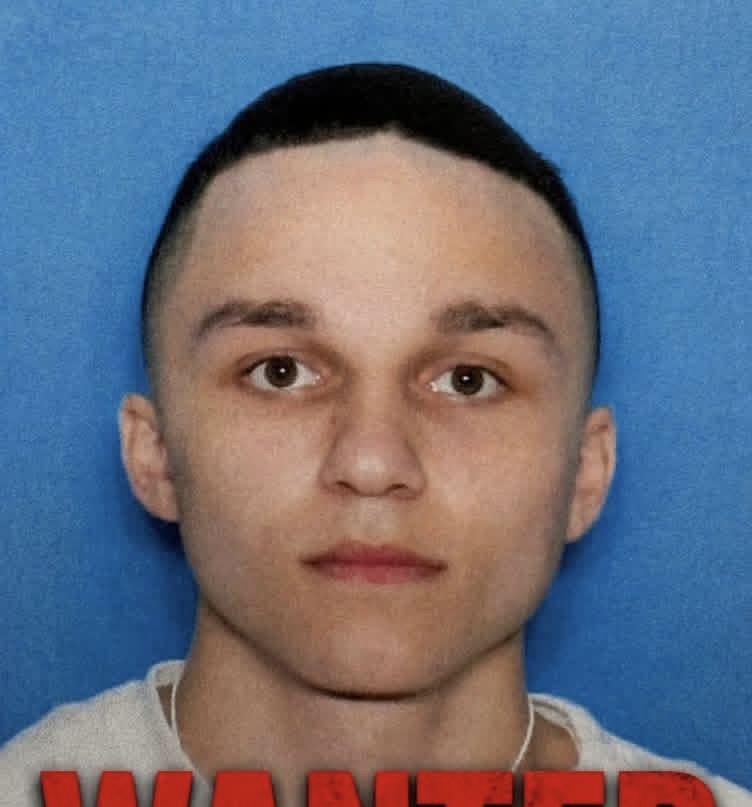
Nicholas Cunningham Dies by Suicide During US Marshals Arrest Attempt in Clinton, LA; Wanted for Attempted Murder in Jackson Shooting That Injured Victim, Corente Anderson Previously Arrested.
CLINTON, La. – A multi-agency manhunt for a suspect in a violent April shooting ended in tragedy Monday morning when the wanted man, Nicholas Cunningham, died by suicide as law enforcement officers moved to arrest him, according to the East Feliciana Parish Sheriff’s Office.
The incident unfolded around 10:35 a.m. in Clinton, Louisiana, a small city about 30 miles northeast of Baton Rouge. Members of the U.S. Marshals Fugitive Task Force had tracked Cunningham to a location in the area, acting on a warrant issued by the Jackson Police Department (likely Jackson, Mississippi, though the original report does not specify state; based on geographical proximity and task force jurisdiction, it is presumed to be Jackson, MS). Cunningham was wanted on one count of attempted murder in connection with a shooting that injured a victim earlier this spring.
Authorities confirmed that as task force officers attempted to execute the arrest, Cunningham took his own life. In a brief but critical statement, the East Feliciana Parish Sheriff’s Office—which noted it was not directly involved in the arrest operation—emphasized that no shots were fired by members of the task force, and no physical force was used during the attempted apprehension.
“The safety of the public and our officers is always paramount. In this instance, the suspect made a fatal decision before any contact could be made,” a spokesperson for the task force later said in an unofficial capacity, though official investigations are ongoing.
—
The April 2 Shooting on Charles Drive
The charges against Nicholas Cunningham stem from a violent incident that occurred on April 2 on Charles Drive —a residential street that local records indicate has seen sporadic criminal activity over the years. Police were called to the scene around evening hours (exact time not released) and found one individual suffering from gunshot wounds.
The victim, whose identity has not been publicly released due to medical privacy laws, was transported to a local hospital. Their current condition remains unknown, but the fact that Cunningham was charged with attempted murder rather than a lesser offense suggests the victim survived but sustained serious injuries.
According to initial police reports from the Jackson Police Department, at least two suspects were involved in the shooting. Corente Anderson, now 24 (age estimated based on public records), was arrested nearly three weeks later, on April 24, in connection with the same incident. Details of Anderson’s arrest—whether he surrendered, was found hiding, or was caught during a traffic stop—have not been released by authorities. Anderson’s current custody status and any charges he faces (attempted murder, aggravated assault, conspiracy) remain unclear, as the Jackson Police Department has not updated its public records since his arrest.
Cunningham, however, evaded capture for more than a month, prompting the involvement of the U.S. Marshals Fugitive Task Force—a federal unit that specializes in tracking down violent offenders who cross state or jurisdictional lines.
—
The Role of the U.S. Marshals Fugitive Task Force
The U.S. Marshals Service operates 56 regional fugitive task forces across the country, combining the resources of federal, state, and local law enforcement. The task force involved in Cunningham’s case likely included deputies from the U.S. Marshals, officers from the Jackson Police Department, and possibly Louisiana state or local law enforcement.
Task forces are typically deployed for suspects who pose a significant danger to the public or who have demonstrated an ability to evade capture. Attempted murder qualifies as a Priority 1 offense, meaning Cunningham would have been among the most wanted individuals in the region.
According to law enforcement sources familiar with such operations, the task force had likely been tracking Cunningham’s movements for days or even weeks, using cell phone data, tips, surveillance, and predictive analysis. The decision to move in on Monday morning at 10:35 a.m. suggests a tactical window—often when a suspect is isolated or less alert.
What exactly happened in those final moments remains under investigation. But early statements confirm: no officer fired a weapon, and no physical restraints were applied. That strongly suggests Cunningham either produced a firearm and shot himself as officers approached, or used another method of self-harm before any confrontation could occur.
“Suicide by cop is a known phenomenon, but here, the officers didn’t even have the chance to engage,” said Dr. Ellen Marchetti, a criminologist at Louisiana State University. “This appears to be a straightforward suicide in the presence of law enforcement, not a provoked shooting. It’s a tragic end for a man who was still entitled to due process.”
—
Who Was Nicholas Cunningham?
Little is known publicly about Nicholas Cunningham prior to April 2. No prior criminal record in Louisiana or Mississippi has been immediately released, though that does not rule out sealed juvenile records or charges in other states.
Neighbors on Charles Drive reportedly described seeing unfamiliar cars in the weeks before the shooting, but no one has come forward with detailed knowledge of Cunningham’s personal life. Social media accounts bearing his name appear to have been deleted or set to private since the incident.
What is clear: at the time of his death, Cunningham was facing a charge that carries, in Mississippi, a potential sentence of life in prison if convicted (attempted murder is punishable by up to 30 years to life, depending on aggravating factors). That harsh penalty, combined with the psychological pressure of being hunted by federal agents, may have contributed to his decision to end his life.
“Fugitives often experience extreme stress—isolation, paranoia, exhaustion,” said Dr. Marchetti. “Some reach a point where they believe death is preferable to capture, especially if they fear a long prison sentence or retaliation.”
—
Corente Anderson: The Other Suspect
The second suspect, Corente Anderson, was arrested on April 24 —22 days after the shooting and roughly 27 days before Cunningham’s death. It is not publicly known whether Anderson provided information that helped law enforcement locate Cunningham, though such cooperation is common in multi-suspect cases.
Anderson’s arrest record, if any, has not been made available. He may be currently held in a Jackson-area jail awaiting trial, or he may have been released on bond. The original news report from the East Feliciana Parish Sheriff’s Office does not specify Anderson’s current status, only that he was “previously arrested in connection with the incident.”
If Anderson faces the same attempted murder charge, his case could now become more complex. With Cunningham dead, Anderson may be the sole remaining defendant. Prosecutors could argue that Cunningham was the primary shooter, or they could proceed with a theory of joint liability, arguing that Anderson participated in the crime (e.g., driving the getaway car, providing the weapon, or acting as a lookout). Without Cunningham’s testimony, however, Anderson’s defense might claim that the deceased suspect was solely responsible.
—
The Scene in Clinton, Louisiana
Clinton, the seat of East Feliciana Parish, is a small community of roughly 1,700 residents. It is not accustomed to high-profile fugitive operations. The town is known for its historic courthouse, antique shops, and proximity to the Louisiana State Penitentiary at Angola—ironically, a prison where Cunningham might have ended up if convicted in Louisiana, though his case was in Mississippi.
The exact location of the arrest attempt has not been disclosed—whether it was a home, a motel, a vehicle, or a public space. What is known is that the East Feliciana Parish Sheriff’s Office was notified but did not participate, a standard procedure when federal task forces operate within a parish’s jurisdiction out of courtesy.
After Cunningham’s death, the area was cordoned off for several hours as crime scene investigators documented the scene. The East Feliciana Parish Coroner’s Office was called to pronounce death and transport the body for an autopsy, which is mandatory in any death involving law enforcement presence, even when no officer fired a weapon.
The Louisiana State Police (LSP) or the East Feliciana Parish District Attorney’s Office may conduct a parallel investigation to ensure that no excessive force or negligence occurred, though early indications suggest a clear-cut suicide.
—
Legal and Procedural Aftermath
When a wanted suspect dies by suicide during an arrest attempt—especially involving federal officers—several protocols are triggered:
1. Internal Review – The U.S. Marshals Service will conduct an administrative review of the operation to determine if any policies were violated.
2. Independent Investigation – By longstanding practice, the local district attorney’s office or state police will investigate the death to rule out foul play or officer involvement. In Louisiana, any death “involving” law enforcement (even without shots fired) typically triggers a review under state law.
3. Notification of Next of Kin – The East Feliciana Parish Coroner’s Office will work to locate Cunningham’s family. His body will not be released until an autopsy and forensic examination are complete.
4. Case Closure – With Cunningham dead, the Jackson Police Department will close its attempted murder case against him, though the investigation into the April 2 shooting may continue if new evidence emerges. The charge against Corente Anderson remains active unless dismissed.
For the victim shot on Charles Drive, legal justice now rests solely on Anderson’s prosecution. Civil remedies—such as a wrongful death or personal injury lawsuit against Cunningham’s estate—are possible but often limited by the deceased’s assets.
—
Broader Context: Fugitive Suicides and Mental Health
Cunningham’s death is not an isolated incident. According to a 2022 study by the U.S. Marshals Service, approximately 3–5% of fugitive apprehensions end in the suspect’s suicide or “suicide by cop.” The stress of being hunted, the fear of violent retaliation from co-defendants or rivals, and the shame of facing family members after a high-profile crime all contribute.
Mental health experts argue that many fugitives suffer from untreated depression, PTSD, or substance abuse disorders. Cunningham, if he had been arrested alive, would have been entitled to a mental health evaluation. Instead, his death leaves unanswered questions: Was he acting alone? Did he have a plan to harm others? Was the shooting on Charles Drive premeditated or a heat-of-the-moment act?
“Every time a suspect dies before trial, we lose the ability to understand the ‘why’ behind a crime,” said Marchetti. “That doesn’t excuse violence, but it hinders prevention.”
—
Community Reaction
In both Jackson and Clinton, reactions have been muted. The Jackson Police Department has not issued a statement beyond the initial warrant, and the family of the April 2 shooting victim has not spoken to media.
On Charles Drive, residents expressed relief that Cunningham is no longer at large, but sadness that he took his own life. “I just wanted him to face what he did,” one neighbor told a local reporter, speaking on condition of anonymity. “Not this.”
In Clinton, locals were surprised to learn that a wanted fugitive had been hiding in their midst. “You think of Clinton as a quiet place,” said a downtown merchant. “Makes you realize nowhere is truly safe, but also that these manhunts end in ways nobody expects.”
—
Ongoing Investigation and Missing Details
Authorities have emphasized that this is a developing story. Several key pieces of information are still missing:
· The exact cause of death – Will be determined by the East Feliciana Parish Coroner’s autopsy.
· Cunningham’s location at the time of death – Was he in a car, a house, or outdoors?
· Whether a weapon was found – If so, its origin (illegal purchase, stolen, etc.) could be relevant.
· Corente Anderson’s current status – Is he still in custody? Has he been charged as an adult? Does he face additional counts?
· The victim’s condition – Has the shooting survivor recovered? Are there permanent injuries?
· Any connection between Cunningham and Anderson – Were they friends, relatives, or criminal associates?
The East Feliciana Parish Sheriff’s Office has not released a timeline for the investigative report. Typically, preliminary findings are available within 72 hours, but full autopsy and toxicology reports can take weeks.
—
How to Get Help
If you or someone you know is experiencing suicidal thoughts, help is available. The 988 Suicide and Crisis Lifeline provides free, confidential support 24/7. Cunningham’s death is a reminder that even individuals accused of serious crimes are human beings capable of despair.
For victims of violent crime, the National Center for Victims of Crime offers resources at victimsofcrime.org.
—
Conclusion
The death of Nicholas Cunningham during an arrest attempt by the U.S. Marshals Fugitive Task Force in Clinton, Louisiana, closes one chapter of a violent April shooting on Charles Drive in Jackson, but opens difficult questions about mental health, fugitive tactics, and the limits of law enforcement. With Corente Anderson already in custody and the original victim still recovering, the legal system will now move forward without Cunningham ever facing a jury.
Authorities continue to investigate the circumstances of the suicide. No officers were injured, and no shots were fired by law enforcement. For the community, the case serves as a stark reminder that even in the pursuit of justice, outcomes can be tragic and irreversible.
Leave a Reply